
Facts
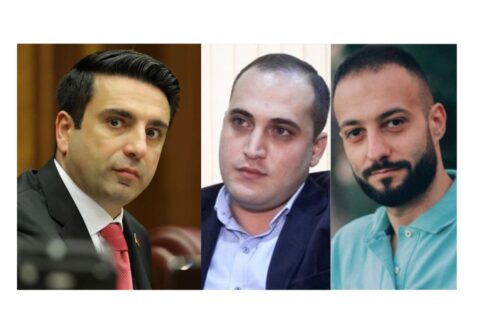
On November 12, 2025, Alen Simonyan, the Speaker of the RA National Assembly, filed a lawsuit with the Court of General Jurisdiction of Yerevan against Vazgen Saghatelyan, the host of “Imnemnimi” podcast (court case No. ED2/12193/02/25). The plaintiff requested the court to oblige the defendant to issue a public apology by publishing an appropriate statement on his personal Facebook page or in a print media with a circulation of no fewer than five thousand copies, including the following in the text: “On 09.11.2025, during the live broadcast of the podcast titled “LIVE: About our episode with the 3rd President, the reactions it triggered, and hysterical outbursts — “Imnemnimi” #223” on www.youtube.com, I made certain remarks about Mr. Simonyan. I hereby declare that those remarks contain offensive expressions about Alen Simonyan, the Speaker of the National Assembly, for which I offer my apology to Mr. Simonyan.” In the lawsuit, the plaintiff also seeks to recover 1 million drams from the defendant as compensation for the insult contained in the video, as well as 410 thousand drams to cover court costs. As of the time this document was being prepared, the court had not yet made a decision on whether to accept the lawsuit for proceedings.
On the same day, NA Speaker Alen Simonyan also filed a similar lawsuit against Narek Samsonyan, the other host of “Imnemnimi” podcast (court case No. ED2/12196/02/25), on the same facts and with identical demands. Here too, the court has not yet made a decision on whether to accept the lawsuit for proceedings.
On November 13, 2025, the day after the lawsuits were filed, Vazgen Saghatelyan and Narek Samsonyan were arrested. Media outlets and social networks circulated videos showing how the arrests were carried out. Later, a search was conducted at the office of antifake.am, a fact-checking and information platform, resulting in the seizure of all video recording equipment. After this, antifake.am journalist David Fidanyan was arrested and remained in custody for around 60 hours before being released. The next day, on November 14, another employee, Ishkhan Khosrovyan, was also arrested and was released a few hours afterward.
According to the spokesperson of the Investigative Committee, Narek Samsonyan and Vazgen Saghatelyan have been charged under paragraphs 2.1 and 2.3 of Article 297 of the Criminal Code (hooliganism committed by a group of individuals through the use of information or communication technologies). On November 13, NA Speaker Alen Simonyan stated in an interview with journalists that criminal prosecution against them had been initiated following his complaint, as the two had insulted and threatened him on air, and that these actions also qualified as hooliganism. On November 14, Narek Samsonyan and Vazgen Saghatelyan were placed in custody for two months through two separate judicial acts. The preliminary investigation into the criminal case is ongoing.
CONCLUSION
Prior to their arrest and detention, Narek Samsonyan and Vazgen Saghatelyan co-authored and hosted “Imnemnimi” podcast, which forms part of antifake.am information website. The episodes of the podcast are released regularly, featuring a permanent title and episode number, and are distributed across several online platforms to an unlimited audience. The topics discussed, as a rule, relate to Armenia’s domestic and foreign policy and the actors involved. The outlined facts allow us to classify the website in question and its podcast as carrying out journalistic activities under Article 3 of the Law “On Mass Communication.” Accordingly, the provisions of domestic and international law on journalistic freedoms and duties are applicable to the co-authors and hosts of “Imnemnimi.”
For more than two decades, the legal system of the Council of Europe (CoE) has firmly upheld the position that imprisonment for defamation or insult is unacceptable, and that such a measure is proportionate only in cases where the insult or defamation is accompanied by hate speech and incitement to violence. The CoE Parliamentary Assembly has adopted a relevant recommendation on this principle.[1] The Committee of Ministers of the Council of Europe, in turn, has proposed that the member states review their legislation and practices to ensure they include freedom of expression safeguards—specifically, the grounds of public interest, proportionality, reasonable publication, and other relevant legal protections. Given that criminal prosecution and imprisonment pose a serious threat to freedom of expression, the CoE Committee of Ministers has also recommended that the member states be guided by the positions outlined in the decisions of the European Court of Human Rights, according to which, the imposition of a prison sentence for a press offence is only permissible in exceptional circumstances, notably where other fundamental rights have been seriously impaired, for example, in the case of hate speech or incitement to violence.[2]
During the relevant episode of the aforementioned podcast, the hosts used profanities and other indecent expressions, which the IDC considers as strictly unacceptable. Unbridled language and insults cannot be accepted as a form of communication with the public and must be subject to legal assessment. At the same time, it is crucial that any assessment and the resulting liability be proportionate, well-founded and fair.
In this case, the available facts indicate that both civil proceedings and criminal prosecution have been launched against Narek Samsonyan and Vazgen Saghatelyan in relation to the same action. The IDC finds this approach unacceptable.
Theoretically, it is possible for an individual to face both civil and criminal liability based on the same facts. However, in the context of producing news content, this can be considered legitimate only if criminal liability does not entail imprisonment. The incarceration of media representatives for insult or defamation, regardless of their gravity, is unnecessary in a democratic society. It is in this light that public relations within the Council of Europe area are presently viewed. Moreover, the imposition of even a minimal financial penalty in the context of criminal prosecution raises concerns, as the very existence of such a sanction itself has a chilling effect on the right to freedom of expression (Maurice v. France, Application No. 29369/10, ECHR, 23/04/2015, paragraph 176). Consequently, the IDC considers the criminal prosecution and imprisonment of Narek Samsonyan and Vazgen Saghatelyan as disproportionate measures. The act in question—the insult—should be subject to legal assessment solely within the scope of civil legislation.
Regarding the position of the criminal prosecution body that the podcast hosts’ offensive remarks amount to hooliganism, the IDC views this to be a dangerous precedent. By classifying public insult as hooliganism, the criminal prosecution body essentially revives, in a disguised manner, the infamous Article 137.1 (grave insult) of the former Criminal Code. That article was severely criticized by Armenian civil society and international human rights organizations and was therefore removed from the Code as a norm posing a threat to freedom of expression.
The search carried out at the antifake.am office and the seizure of its editorial equipment should also be viewed in the context of the considerations mentioned above. Given that the controversial remarks were made publicly in an online setting, it is logical to assume that such harsh actions by law enforcement, namely the National Security Service, were not needed: the evidence for the hooliganism allegations against Narek Samsonyan and Vazgen Saghatelyan is available on the Internet and open for anyone to view, making it unnecessary to identify and record it through a search and seizure of equipment. Whatever purpose the investigative body may have had in taking such steps, the fact remains that they resulted in the disruption of news reporting, which is tied to the public interest.
The manner in which Narek Samsonyan and Vazgen Saghatelyan were arrested is also unacceptable. First, the number of officers involved was several times higher than the number of persons being arrested, considering that the latter did not show any resistance. Furthermore, questions arise as to why the arrest process was being filmed while several officers from the criminal prosecution body were twisting the arms of the detainees and escorting them from their homes in the presence of family members, neighbors, and bystanders. Additionally, on what grounds did the officer conducting the arrest prohibit a citizen from recording the enforcement action in a public area? The IDC states that the arrest involved disproportionate and harsh force, which was not intended to ensure public safety, securely transport the detainees or neutralize their unlawful resistance, but rather to humiliate them. The IDC expresses hope that, irrespective of whether a relevant complaint has been submitted, the competent state body will conduct the necessary investigation into the incident of mistreatment, and those responsible will be held accountable.
In conclusion, the IDC determines that the authorities responded disproportionately to the actions of Narek Samsonyan and Vazgen Saghatelyan and subjected them to degrading mistreatment.
Information Disputes Council
Shushan Doydoyan (IDC Secretary), President of Freedom of Information Center
Boris Navasardian, Honorary President of Yerevan Press Club
Ara Ghazaryan, Director of “Ara Ghazaryan” Law Firm
Aram Abrahamyan, Chief Editor of “Aravot” Daily
Ashot Melikyan, Chairman of Committee to Protect Freedom of Expression
Olga Safaryan, Lawyer
[1] Council of Europe Parliamentary Assembly Resolution 1577 (2007) towards decriminalization of defamation, paragraphs 17.1 and 17.5
[2] CM/Rec(2016)4 – Recommendation of the Committee of Ministers to member states on the protection of journalism and safety of journalists and other media actors, paragraph 6