
FACTS
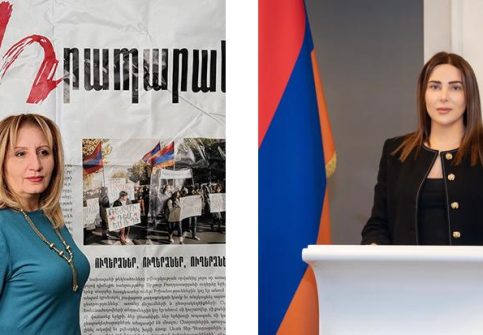
On September 19, 2022, Yelena Zohrabyan, the Head of Public Relations Department at the Urban Development, Technical and Fire Safety Inspectorate (hereinafter referred to as the Inspectorate), filed a lawsuit with the Court of General Jurisdiction of Yerevan against Susanna Simonyan, a journalist of Hraparak daily newspaper (court case No. ED/48584/02/22). The lawsuit, filed under Article 1087.1 of the Civil Code, alleged that the journalist had publicly insulted Zohrabyan. According to the lawsuit, on August 14, 2022, following the well-known explosion at “Surmalu” market in Yerevan, a number of media outlets reached out to Yelena Zohrabyan seeking information regarding the incident. Over the course of that day and the following days, she responded to more than one hundred phone calls from journalists. There were cases where calls were missed; however, she ensured that they were returned or responded in writing.
On August 16, two days after the incident, Hraparak daily journalist Susanna Simonyan, made the following post on her personal Facebook page: “I suggest that spokespersons like Yelena Zohrabyan, whose mission consists of sitting idly, getting paid and occasionally dusting off their boss, be henceforth called ‘Press Brushes’.” After some time, the post was edited and republished with the following wording: “I suggest that persons like Yelena Zohrabyan, the spokesperson at the UD Fire Safety Inspectorate, whose mission consists of sitting idly, getting paid and occasionally dusting off their boss, be henceforth called ‘Press Brushes’.” The edited version specifically highlighted Yelena Zohrabyan’s public role. The plaintiff requested that the court oblige the defendant to issue a public apology for the insult and pay compensation in the amount of 2 million AMD.
The defendant objected to the lawsuit, explaining that in her capacity as a journalist she had been covering the explosion and its consequences. She pointed out that the RA Urban Development, Technical and Fire Safety Inspectorate, where Yelena Zohrabyan handled public relations, was the state body responsible for the disaster. The defendant further stated that she had made multiple attempts to contact the plaintiff to obtain responses to urgent inquiries, but these calls were left unanswered. It was also noted that another employee of the daily had also tried to reach out to Yelena Zohrabyan, but those calls likewise remained unanswered. According to the defendant, she decided to make the aforementioned social media post to demonstrate how the inaction of a public official had made it impossible for journalists to carry out their professional activities. In doing so, the defendant placed a particular emphasis on the fact that the necessary work was not being performed, and that the Head of the Public Relations Department of the Inspectorate avoided providing information to the media.
According to the defendant, the expression “to dust off the boss” was used to describe the official’s failure to fulfill her duties, and, in common usage, characterizes inaction. Regarding the term “press brush,” the journalist noted that it was a humorous expression referring to the aforementioned idea of “dusting off,” and did not carry a negative meaning of such gravity as to amount to tarnishing an individual’s honor, dignity, or business reputation. Susanna Simonyan further stated that she did not know Yelena Zohrabyan and had never met her; consequently, she had no intent or deliberate purpose to insult her personally and used the expressions in question exclusively to evaluate the plaintiff’s public activities.
On November 11, 2024, the court partially upheld the lawsuit, concluding that the journalist had insulted and tarnished the plaintiff’s dignity. The court obliged Susanna Simonyan to issue a public apology and pay 100 thousand AMD in compensation to the plaintiff, along with 23 thousand AMD in state duty. The remainder of the compensation claim was rejected.
The defendant appealed the ruling to the Civil Court of Appeal. On September 26, 2025, the appellate court overturned the first instance court’s decision and rejected the lawsuit in its entirety. The court reasoned that the controversial post was not so much about Yelena Zohrabyan or aimed at insulting her personally, but rather represented a manifestation of the journalist’s concern about the potential inaction of the competent state bodies in relation to the incident that had occurred. According to the court, the post did not contain a direct insult, while the expression “press brush” was not even part of public discourse, having appeared for the first time and being of an episodic nature. The appellate court also stated that the phrase had been used rather figuratively and closely resembled a made-up expression, indicating the defendant’s view that the press secretary was not fulfilling her duties.
At the same time, the court acknowledged that the controversial post may indeed have been unpleasant for Yelena Zohrabyan; however, according to the court, Zohrabyan should have taken into account that given her role, she had direct responsibilities to maintain communication with media representatives, and in the course of such interactions, the responses could naturally have given rise to criticism that was unpleasant. The Court of Appeal also found that the arguments presented in the complaint regarding the absence of intent on the part of the defendant to insult the plaintiff were well-founded, and that the contested idea had been articulated in a figurative and abstract sense.
The plaintiff challenged this decision before the Court of Cassation, which has not yet delivered its judgment on the appeal.
CONCLUSION
The Information Disputes Council considers that the controversial post could not be regarded as containing factual information, as had been concluded by the court of first instance, since the journalist had expressed a figurative assessment of the performance of a public official. It therefore constitutes a value judgment which, under the case-law of the European Court, is not susceptible of proof (Lingens v. Austria, Application No. 9815/82, 08/07/1986). In this regard, the IDC agrees with the position of the Civil Court of Appeal that the expressions in question were made-up and used in a figurative sense.
Nevertheless, the court’s conclusion regarding value judgments is neither adequately reasoned nor clearly formulated. Meanwhile, this factor is crucial for the resolution of the dispute, since when determining the legitimacy of using expressions figuratively, the central consideration is whether they derive from certain factual grounds. According to the legal positions set forth by the European Court of Human Rights and the RA Court of Cassation, a value judgment cannot be expressed abstractly, but must be based on a specific set of facts (Decision of the Court of Cassation of 18/10/2019 in Civil Case No. EADD/2612/02/16).
In this regard, the IDC, in contrast to the appellate court, finds that the value judgments made figuratively in this case lacked sufficient factual ground, and that this circumstance was not properly examined by the court. In particular, the main emphasis was placed on the fact that the journalist’s four calls to the plaintiff within roughly thirty minutes following the market explosion were not answered, yet insufficient attention was given to the fact that there had been nearly one hundred other phone calls from numerous media outlets on the same matter, making it impossible to answer all of them at once. This is particularly relevant given that the Inspectorate was conducting intensive consultations to assess the situation and implement operational measures, requiring the press officer to participate in these discussions to properly report to the public. Another important point that received minimal attention from the court is that the public official returned the journalist’s call, yet it went unanswered. In other words, the plaintiff did not avoid talking to the media representative. However, the following day, the journalist published the controversial post on her Facebook page.
The IDC considers that the existing set of facts does not provide sufficient grounds to claim that the plaintiff, as a public official, failed to fulfill her duties. Consequently, the characterization given by the journalist is offensive. A post of this nature would necessitate manifestations of repeated patterns of conduct over a prolonged period that could cast a shadow on the given official’s work and its transparency. The absence of sufficient factual grounds also points to the defendant’s intent to insult.
In this case, the IDC does not consider the Court of Appeal’s position – that “harsh criticism may also occur within the scope of media activities, especially in situations where there is an absence of basic communication between a journalist covering a high-profile case and the authorized representative of a state body” – to be well-founded, since reaching such a conclusion would have also required a sufficient factual framework and a more objective analysis of the circumstances of the dispute.
Considering the above, the IDC concludes that the Civil Court of Appeal failed to fairly balance the defendant’s freedom of expression against the plaintiff’s right to have her dignity respected, thereby breaching the guarantee established by Article 31(1) of the Constitution of the Republic of Armenia.
Information Disputes Council
Shushan Doydoyan (IDC Secretary), President of Freedom of Information Center
Boris Navasardian, Honorary President of Yerevan Press Club
Aram Abrahamyan, Chief Editor of “Aravot” Daily
Ashot Melikyan, Chairman of Committee to Protect Freedom of Expression
Ara Ghazaryan, Director of “Ara Ghazaryan” Law Firm
Olga Safaryan, Lawyer