
FACTS
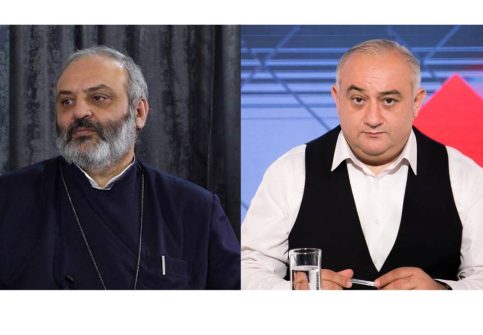
On June 25, 2025, the RA Investigative Committee published on its official website an announcement titled “Participants and leaders of the “Holy Struggle” movement planned to carry out terrorist acts and activities aimed at seizing power in the Republic of Armenia.” On the same day, Petros Ghazaryan, a host at the Public TV, made the following post on his Facebook page:
“One component in this terrorist process went unnoticed. The terrorists have received and continue to receive great media support from Satik-like figures. Lies, disinformation, half-truths, emotionalism, a sense of chaos, and inevitability of crisis: Satik-like figures disseminate all this on a daily basis. Through their daily work, they created and nurtured Osama bin Srbazan (Translator’s note: “Srbazan” is the Armenian word for “Reverend”), who calls his own people “beasts” and guns people down. They are similar.
For several days now, the Dashnaks’ Yerkir.am has been writing that Erdogan was surprised in Istanbul by the extent of Pashinyan’s concessions. I don’t know, perhaps Erdogan personally told the Dashnak outlet about his surprise. But such lies fully fit into the program of the holy terrorists.”
On July 25, 2025, Vazgen Galstanyan filed a lawsuit with the Court of General Jurisdiction of Yerevan against Petros Ghazaryan under paragraphs 2 and 3 of Article 1087.1 of the Civil Code (court case No. ED2/7778/02/25). The plaintiff argued that the publication contained insulting and defamatory expressions. According to the plaintiff, the expressions “Osama bin Srbazan” and “They are similar” were insulting, as they compared him to Osama bin Laden. He also claimed that the expressions “The terrorists have received and continue to receive great media support from Satik-like figures,” “Through their daily work, they created and nurtured Osama bin Srbazan, who calls his own people “beasts” and guns people down,” “Such lies fully fit into the program of the holly terrorists” were defamatory. The plaintiff demanded a refutation of the publication and compensation of 1 million drams for insult and 2 million drams for defamation.
The court rejected the lawsuit in its entirety. According to the ruling, the expression “Osama bin Srbazan” constituted a value judgment supported by sufficient factual grounds outlined in the statement of the Investigative Committee, and was therefore considered lawful. The court further reasoned that in the course of his professional activities, the journalist had searched for and collected publications related to the incident and, in exercising his right, had edited the material and expressed his point of view on the situation, providing his own assessment. With regard to the expression “They are similar,” the court found that it had been stated in general terms, making it unclear what or whom the similarity referred to, and that it was essentially a comparative judgment.
Referring to the expressions considered by the plaintiff to be defamatory, the court concluded that they could not be qualified as defamation, since they had been made by the defendant in general terms, did not contain specific information about the plaintiff concerning any particular action or inaction, and that receiving great media support could in no way be interpreted as a statement of fact tarnishing an individual’s honor, dignity, or business reputation. The verdict was appealed to the Civil Court of Appeal, with no hearing date set yet.
CONCLUSION
Based on the above facts, the plaintiff argued that some of the disputed expressions were value judgments containing insults, while others amounted to defamation. In his assessments, the defendant, a journalist and host of TV programs of public interest, called the plaintiff a terrorist on his personal Facebook page and drew a comparison with Osama bin Laden, who was responsible for organizing and carrying out major international terrorist acts that resulted in thousands of deaths. Making such a comparison publicly requires solid and sufficiently comparable facts. The IDC agrees with the court’s conclusion that the first two of the aforementioned expressions were value judgments, and that the defendant’s comparison was made in an allegorical manner.
The European Court of Human Rights has also addressed the use of such harsh comparisons in political discourse. However, the ECHR has focused on whether such comparisons were made as part of political satire, since style, just like content, is equally protected by the right to freedom of expression (Uj v. Hungary, Application No. 23954/10, 19/07/2011, § 20). Accordingly, stylistic exaggerations, even if accompanied by sarcasm or vulgar language, may fall within the scope of protection of freedom of expression (REDAKTSIYA GAZETY ZEMLYAKI v. Russia, Application No. 6224/05, 21/11/2017, § 48; see also the IDC Opinion No. 50).
Nevertheless, in this case, there is nothing to suggest that the disputed post was part of any journalistic genre (such as a feuilleton, pamphlet, etc.), which implies and allows the inclusion of certain exaggerations, metaphorical comparisons, or allegories. The defendant used the expressions on his Facebook page, and they do not constitute an integral part of any journalistic piece. Consequently, the author of the post cannot, in this case, benefit from the legal protection guarantees envisaged for journalistic activities. In the present case, referring to the person as a terrorist and comparing him to an international terrorist in the aforementioned text constitutes an exaggeration that goes beyond what is necessary in the context of public interest. Furthermore, the IDC also draws attention to the fact that the Investigative Committee’s statement, which the defendant and later the court treated as a sufficient factual basis for a value judgment, did not contain any assertion of the plaintiff’s guilt. The statement presented facts and assessments related to the charges, without violating the presumption of innocence and, even more so, not describing the person as a terrorist.
In light of the above, the IDC concludes that by using the expressions “Osama bin Srbazan” and “They are similar,” the defendant exercised his right to express value judgments in bad faith, violated the plaintiff’s presumption of innocence, belittled his dignity, and insulted him. Regarding the court’s position on not classifying the remaining expressions as defamation, the IDC agrees that, despite containing a certain degree of sarcasm, they are not shocking and disturbing to such an extent as to exceed the minimum threshold of the legal definition of defamatory speech established by judicial practice.
Information Disputes Council
Shushan Doydoyan (IDC Secretary), President of Freedom of Information Center
Boris Navasardian, Honorary President of Yerevan Press Club
Aram Abrahamyan, Chief Editor of “Aravot” Daily
Ashot Melikyan, Chairman of Committee to Protect Freedom of Expression
Ara Ghazaryan, Director of “Ara Ghazaryan” Law Firm
Olga Safaryan, Lawyer